
Nguyen Văn Bo (1), Hoang Kim (2), Rod Lefroy (3), Keith Fahrney (3), Reinhardt Howeler (3) Hernan Ceballos (3)
ABSTRACT
Cassava in Vietnam Vietnam Vietnam Vietnam Vietnam The Ministry of Agriculture and Rural development (MARD) has planned to remain cassava area around 450.000 hectares from 2011 to 2015 and efforts to increase fresh root yield from 16.90 to 20.00 ton/ha in 2011 and 23.00 - 24.00 ton/ha in 2015 (MARD 7256/TB-BNN-VP 25 12 2009). Vietnam is now probably the second largest exporter of cassava products (chip and starch), after Thailand Vietnam ’s cassava exports are China and Taiwan , Japan , Singapore , Malaysia , South Korea and countries in Eastern Europe . Besides, animal feed factories also contributed significantly to the increasing demand for cassava roots. Although in Vietnam Vietnam
Key words: Cassava in Vietnam, Bio-fuel
1 Vietnam Academy of Agricultural Sciences (VAAS), nvbo@hn.vnn.vnn
2 Nong Lam University (NLU), Linh Trung, Thu Duc, Ho Chi Minh City, Viet Nam, hoangkim_vietnam@yahoo.com; http://cropsforbiofuel.blogspot.com
3 International Center for Tropical Agriculture (CIAT), Cali, Colombia; h.ceballos@cgiar.org ; CIAT c/o FCRI, Dept. of Agriculture, Chatuchak, Bangkok, 10900 Thailand, r.howeler@cgiar.org


Lessons from CassavaViet
Six essential conditions for a successful cassava R&D program include: Materials, Markets, Management, Methods, Manpower and Money (6 Ms).
Main experiences in linking cassava R&D activities in Vietnam include:
1) Establishment of the Vietnam Cassava Program (VNCP) including advanced cassava farmers, researchers, extension worker, managers of cassava research and development projects, cassava trade and processing companies.
2) The establishment of on-farm research and demonstration fields (farmer participation research FPR)
3) Ten mutual link-up activities (10 T – in Vietnamese):


CONCLUTION:
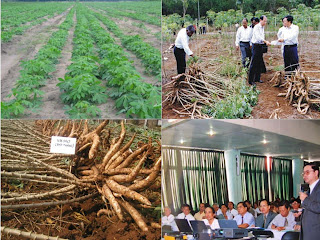
Lessons from Vietnam (Trip report of Mr. Boma)
“Vietnam is a classic example of how cassava can contribute to rural industrialization and development. Previously, people were reluctant to grow cassava because they thought that cassava caused soil degradation and produced low profits. But in reality one hectare of cassava can produce 60-80 tones of fresh roots and leaves. The situation has changed because of the development of sustainable cultivation techniques and new high-yielding varieties with the availability of a large and growing market demand. Cassava has become a cash crop in many provinces of Vietnam. Cassava chips and starch is now being produced competitively, and cassava markets are promising. The combination of wide spread production of fresh cassava roots and the processing of cassava into chips starch and ethanol has created many jobs, has increased exports, attracted foreign investment, and contributed to industrialization and modernization of several rural areas”.


Fictures: Boga Boma and Nigerians biofuel group visit to Vietnam
HOPE RISES ON ETHANOL FROM CASSAVA

CROPS FOR BIOFUEL to follow up 234NEXT.COM. By Ayodamola Owoseye December 20, 2009. With the whole world clamouring for reduction in the burning of carbon in order to slow down the effects of global warming, Nigeria may soon be able to reduce its carbon emission by using ethanol fuel as substitute for kerosene. (Picture: Dwindling cassava cultivation inhibits the planned conversion of cassava to ethanol for energy production)
More ...
Boma Anga, the chief executive officer of Cassava Agro Industries Service Ltd (CAISL) said in a telephone interview that Nigerians will soon be able to use ethanol across the country as an option for household cooking fuel.
"Nigerians will be able to purchase ethanol fuel for cooking by March 2010," said Mr. Anga. "The cooking fuel also known as Cassakero (cassava-kerosene) will be available to the public as an alternative to kerosene in order to reduce the money spent on fuel usage by most families," Mr. Anga added.
Ethanol as substitute
The idea of looking for a substitute for the carbonised cooking fuel (kerosene) and wood came as a result of the harmful impact on the environment and climate change.
Since carbon burning has been identified as one of the reasons for climate change, the world decided to look for alternative means in terms of biofuel, which is renewable fuel derived from biological matter, for instance biodiesel, biogas, and methane which are all believed to have less hazardous impact on the ecosystem.
Mr. Anga said the Cassakero initiative was planned as substitute for kerosene and wood for Nigerians through the production of ethanol from cassava root.
"This is to promote the use of ethanol as a substitute for kerosene in the country as this will reduce the greenhouse effect caused by the use of carbon fuel. The programme is targeted toward installing about 10,000 small-scale bio ethanol refineries in the 36 states of the federation, including the FCT, over the next four years, to produce daily ethanol cooking fuel requirement for four million families," he said.
Food security
But the project is raising concerns about food security as cassava is a major staple of most Nigerians. It is used in producing flour which is made into a paste and the popular garri, eaten in most homes across the land.
Mr. Anga, however, said the project will not have any negative effect on cassava supply in the market nor will it affect food security as the companies will be using specially cultivated, industrial cassava.
"Considering the tonnes of cassava required for the project, I want to assure you that it will not endanger food security as we will be using non-edible industrial variety of cassava which will be planted on fresh land.
"We have already established a feedstock supply that will produce eight million tonnes of cassava at an average yield of 25 tonnes per hectares from 320,000 hectares to be planted nationwide. To also ensure a steady supply of cassava for the feedstock, we have signed a contract with Nigerian Cassava Growers Association (NCGA) to supply eight million tonnes of cassava tubers," he added.
He said the contract would benefit over 250,000 cassava farmers across the country with additional 400,000 hectares to be deployed for cassava cultivation as the refinery will require 40 hectares of cassava to supply 100 per cent feedstock requirement annually.
Cassava farmers welcome the initiative
Cassava farmers see this as a welcome initiative, as it will increase the market for the produce and encourage more people to embark on farming.
Jimoh Bashir, a cassava farmer, said the initiative is a good one as this will allow more farmers to cultivate the crop more, knowing that there is a market for it as compared to when farmers had to seek for buyers to buy the commodity from them.
"This is a nice initiative that we hope will last long as it will open up the market," Mr. Bashir said.
"Most of what is produced in the country is used in the food sector. Having the product used in the industries will only enhance our financial status as this means there will be more produce with a ready market. This means most of the farmers that have abandoned farming will be lured back to it," he said.
Mr. Bashir is, however, concerned about the affect of this on food production in the country as there is a tendency for farmers to change from producing edible cassava for the industrialised ones.
"This might, however, pose a threat to the production of edible cassava by farmers. Farmers will tend to concentrate more on producing the industrial cassava root with a ready market and use, than cultivating the normal ones. This might also affect the market price of the crop," he said.
Economic implications for Nigerians
With the federal government's plan to deregulate the downstream oil sector which might lead to a sharp increase in the prices of petroleum products, especially kerosene, the domestic cooking fuel for most households, the average Nigerian will have to spend more on the purchase of the product or seek alternative means such as coal or wood which will further endanger the environment.
Mr. Anga arued that ethanol will be cheaper and available for the masses as it burns slower than the normal kerosene fuel.
"The new fuel will be locally produced; and provide Nigerians with a new household fuel for use in cooking, lighting, heating, refrigeration and electricity generation. This fuel will be cleaner, safer and cheaper than kerosene without the need for government subsidy and the introductory price will be retailed at about N75 per litre," he said.
"The production and the distribution of the ethanol based appliances will create employment and wealth to investors and the nation in general. The programme will also create sustainable employment and reduce poverty and deforestation while enhancing food and energy security in the Nation.
"The primary goal is to make ethanol as a cooking fuel available, accessible and affordable, in a commercially profitable and sustainable manner, to low income Nigerians," he added.


